
Rent to rent (R2R) is a property arrangement where a company or individual rents a property from the owner, pays the owner an agreed rent, and then lets the property to someone else: tenants, sharers or short-stay guests. The operator keeps the difference between the rent it pays and the income it earns. For landlords it is often marketed as guaranteed rent.
Done properly, rent to rent can give a landlord a predictable monthly income with no voids and little day-to-day involvement. Done badly, it can leave an owner in breach of their mortgage, uninsured, or with occupiers in the property they never agreed to. This guide explains how it works from the landlord’s side, and what to check before signing anything.
How Rent to Rent Works
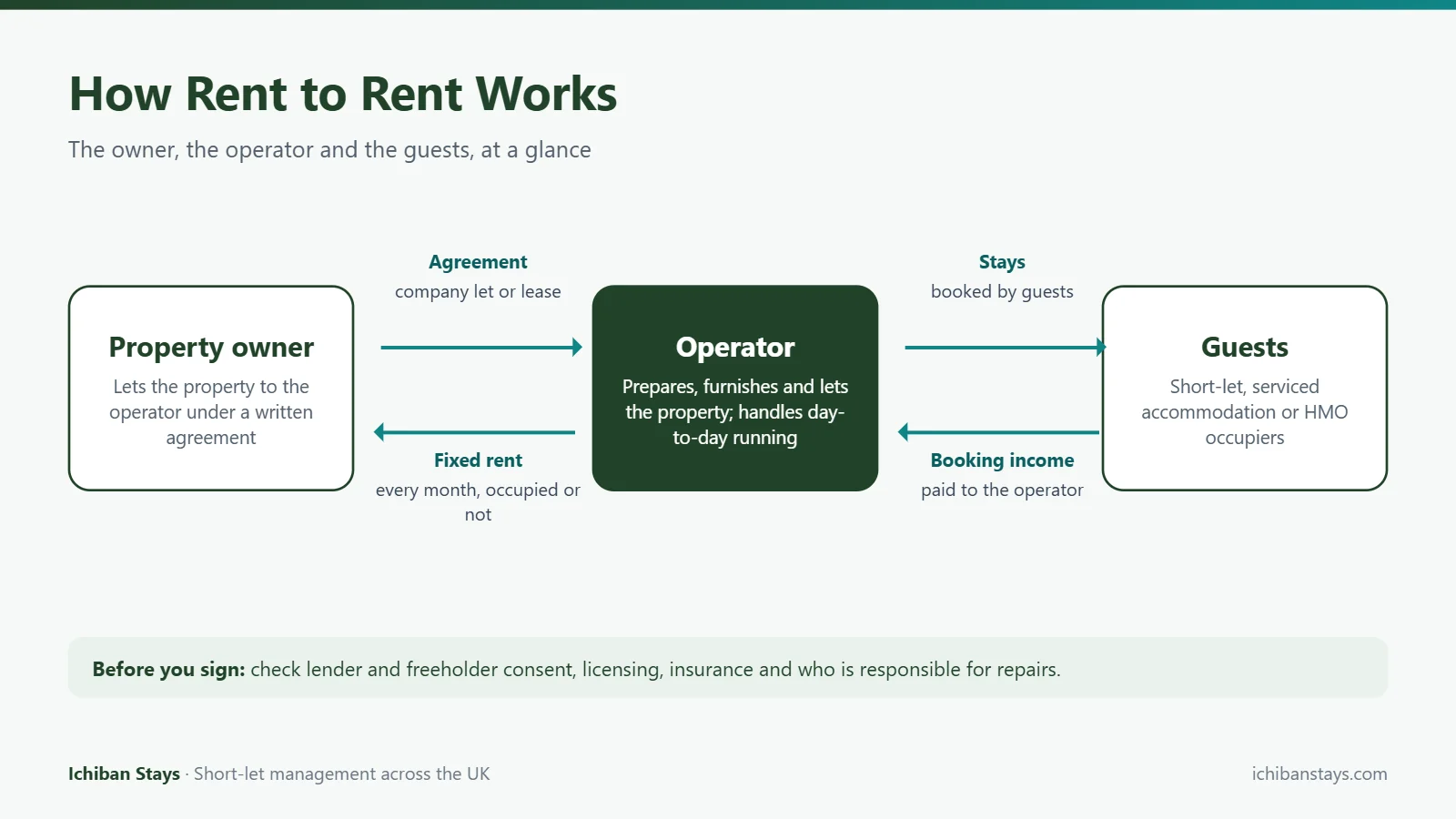
- The owner and the operator agree a fixed rent, a term (often several years) and who is responsible for what.
- The operator takes on the property under a written agreement, commonly a company let or a lease to the operator’s company.
- The operator furnishes or prepares the property if needed, and lets it out. That might be as a house in multiple occupation (HMO), to corporate guests as serviced accommodation, or as short lets on platforms such as Airbnb.
- The owner receives the agreed rent each month, whether or not the property is occupied.
Is Rent to Rent Legal in the UK?
Yes, rent to rent is legal when it is set up properly. The arrangement itself is simply a letting followed by a sub-letting with the owner’s knowledge and consent. Problems arise when the paperwork, permissions or licensing are wrong. Before agreeing, a landlord should make sure each of the following is in place.
1. Mortgage lender consent
Many buy-to-let mortgages restrict letting to companies, sub-letting, or use as short lets. Ask your lender in writing whether the proposed arrangement is permitted. Letting without consent can put you in breach of your mortgage terms.
2. Freeholder or lease consent
If the property is leasehold, check whether the lease allows sub-letting, letting to a company, or short-term letting. Many flat leases restrict use to a private residence and prohibit business use.
3. Insurance
Standard landlord insurance may not cover a property let to a company and then sub-let, and is unlikely to cover short-stay guests. Confirm with your insurer, and ask the operator what cover it holds, including public liability.
4. Licensing and planning
If the property will be let as an HMO, it may need a licence from the council. Some councils also run additional or selective licensing schemes. For short lets, planning rules apply: in Greater London an entire home can be short-let for no more than 90 nights a year without planning permission, Scotland requires a short-term let licence, and Wales requires registration with the Welsh Revenue Authority. England’s national short-term let register is expected to begin in March 2027. Agree in writing who is responsible for each requirement.
5. The agreement itself
Under the Renters’ Rights Act 2025, most residential tenancies in England became assured periodic tenancies from 1 May 2026. Company lets, where the tenant is a company rather than an individual living in the property, fall outside those rules. That is one reason why the structure of the agreement matters. Have a solicitor review it, and make sure it covers:
- the rent, payment dates and any rent reviews;
- the term, break clauses and how the property is returned;
- who is responsible for repairs, maintenance and safety certificates;
- how the property may be used and by whom;
- what happens if the operator stops paying.
6. Redress and professional standards
Businesses in England that carry out lettings agency or property management work must belong to a government-approved redress scheme. Ask which scheme the operator belongs to, and check its company details on Companies House.
The Benefits for Landlords

- Predictable income: a fixed monthly rent, with occupancy risk carried by the operator.
- No void periods: you are paid while the property is empty between guests or tenants.
- Less day-to-day work: the operator deals with occupiers, cleaning and routine issues.
- Property presentation: operators letting to guests have a strong incentive to keep the property in good condition.
The Risks, and How to Reduce Them
| Risk | How to reduce it |
|---|---|
| The operator stops paying | Check its trading history and accounts; ask for a deposit or guarantee; include clear termination terms. |
| Unlicensed or non-compliant use | Agree in writing who obtains licences and certificates, and ask to see them. |
| Breach of mortgage or lease | Get written consent before the agreement starts. |
| Wear and tear from high turnover | Agree inspection rights, condition reports and a return-condition clause. |
| Lower income than managing it yourself | Compare the guaranteed figure with a managed projection before deciding. |
Rent to Rent vs Guaranteed Rent vs Full Management
“Rent to rent” usually describes the operator’s business model, and “guaranteed rent” describes what the landlord receives. In practice, they are often the same arrangement viewed from opposite sides. The real choice for a landlord is between a fixed payment and a share of the actual income:
- Guaranteed rent: a fixed amount every month, with the operator taking the occupancy risk and the upside. See how our guaranteed rent works.
- Full management: the income from bookings, less a management fee. You keep more of the upside but also the variability. See our short let management and Airbnb management services.
Questions to Ask Any Rent-to-Rent Company
- How long have you been operating, and can I speak to existing landlords?
- How will my property be used, and what type of occupiers will stay?
- What agreement do you use, and who drafted it?
- Who handles licensing, safety certificates and repairs?
- Which redress scheme do you belong to, and what insurance do you hold?
- What happens at the end of the term or if either side wants to leave early?
A Simple Illustration
To show how the numbers work on a typical rent to rent property, imagine an owner who could earn a variable income from a managed short let, with some strong months and some quiet ones, plus cleaning, utilities and management costs. An operator might instead offer a fixed monthly rent below the average gross short-let income, but with no voids, no running costs to the owner and no exposure to quiet months. The owner gives up some potential upside in exchange for certainty. Whether that trade-off makes sense depends on the owner’s finances, appetite for risk and the quality of the operator. This is an illustration only, not a quote.
Red Flags When Choosing a Rent-to-Rent Company
- No written agreement, or pressure to sign quickly without legal advice
- Vague answers on how the property will be used or who will stay
- No proof of insurance, redress scheme membership or trading history
- Promises that seem far above market rents
- Reluctance to let you inspect the property during the term
HMOs, Serviced Accommodation and Short Lets
Operators use different strategies. Some convert family homes into houses in multiple occupation (HMOs) and let rooms to individual tenants, which usually needs an HMO licence and may need planning permission. Others run the property as serviced accommodation for corporate guests and contractors, or as short lets on platforms such as Airbnb and Booking.com. Each strategy has different licensing, planning, insurance and wear-and-tear implications, so ask the operator exactly how your property will be used before you agree.
How the Agreement Ends
At the end of the term, the property should be returned in the agreed condition, with any furniture or fixtures dealt with as the contract specifies. Check-out inspections, condition reports and a clear process for disputes protect both sides. If you plan to sell or move back into the property, make sure the agreement’s term and break clauses allow for it.
Frequently Asked Questions
Can I end the agreement early?
Only under the terms of the contract, which is why break clauses and notice periods matter.
Who pays the bills?
It depends on the agreement; often the operator pays utilities and council tax during the term.
Tax and Accounting Points to Discuss With Your Adviser
Rent received under a rent-to-rent or guaranteed rent agreement is still rental income for the owner and is taxed in the usual way. If you previously ran the property as a furnished holiday let yourself, note that the special furnished holiday let tax regime was abolished from 6 April 2025, so the treatment of short-let income has changed. Mortgage interest relief, allowable expenses and capital gains on a future sale can all be affected by how the property is let. Speak to an accountant before you sign, so you understand the after-tax position of each option.
Considering Guaranteed Rent for Your Property?
Ichiban Stays has more than 20 years of experience in London short-term rentals and hospitality. We offer landlords a choice between guaranteed rent and fully managed short lets, and we will show you both options side by side. Book a free property assessment or call +44 7572 190291.
This guide is general information, not legal, tax or financial advice. Take independent legal advice before entering any rent-to-rent or guaranteed-rent agreement.
Related Reading
See how our guaranteed rent works, read our guide to guaranteed rent for London landlords, or compare fully managed short lets.
Contact Ichiban Stays
Ichiban Stays
25 Hill Street, Mayfair, London W1J 5LW, United Kingdom
Phone: +44 7497 355777 or +44 7572 190291
Email: contact@ichibanstays.com
Hours: Monday to Friday, 9:00 to 18:00 UK time